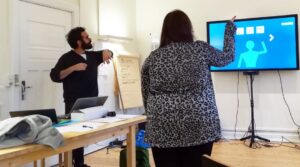
Touch or touchless?: evaluating usability of interactive displays for persons with autistic spectrum disorders
Interactive public displays have been exploited and studied for engaging interaction in several previous studies.

Visit our Scientific Research Area: a section dedicated to professionals in the field, where you can find official resources—official documents, publications, and advanced research—on the scientific research topics of the synbrAIn team.
Interactive public displays have been exploited and studied for engaging interaction in several previous studies.
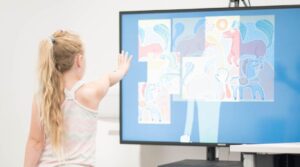
During the last decade, touchless gestural interfaces have been widely studied as one of the most promising interaction paradigms in the context of pervasive displays. In particular, avatars and silhouettes have been proved to be effective in communicating the touchless gestural interactivity supported by displays.

Touchless gestural interaction has been widely studied and adopted in many contexts. Furthermore, the growing availability of low-cost enabling devices, such as Kinect or Leap Motion, boosted up the interest in such interaction both for commercial and scientific purposes, both for large public displays and for personal displays.

The health sector has traditionally been one of the early adopters of databases, from the most simple Electronic Health Record (formerly Computer-Based Patient Record) systems in use in general practice, hospitals and intensive care units to big data, multidata based systems used to support diagnosis and care decisions.
Reports on the 7th ACM International Symposium on Pervasive Displays that took place from June 6-8 in Munich, Germany.
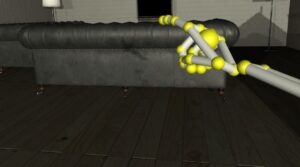
Virtual Reality (VR) is more accessible than ever these days. While topics like performance, motion sickness and presence are well investigated, basic topics as VR User Interfaces (UIs) for menu control are lagging far behind.

The use of plants as a mean for both visualization and interaction has been already explored in smart environments. In this work, we explore the possibility of constructing a controllable dynamic plant-based display using thigmonastic plants, i.e. plants that change the shape and position of their leaves as a response to external stimuli.
In this paper, we shortly introduce our idea of a sound-based system to overcome the display blindness, and some experiments that we are carrying out in order to test its effectiveness.

Many prior works investigated the potential of pervasive technologies and interactive applications to increase access capabilities to digital content for people with disability, particularly Neuro-Developmental Disorders (NDDs).
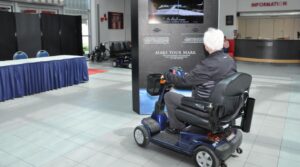
Touchless systems can promote the independence of patients with reduced mobility in accessing information systems, and therefore tertiary prevention.
