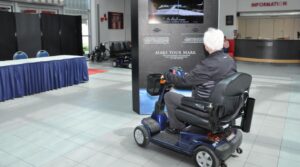
Touchless solutions for tertiary prevention
Touchless systems can promote the independence of patients with reduced mobility in accessing information systems, and therefore tertiary prevention.

Learn more about human-machine interaction: advanced technologies, AI, and solutions to improve the user experience.
Touchless systems can promote the independence of patients with reduced mobility in accessing information systems, and therefore tertiary prevention.
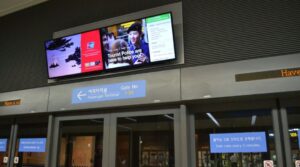
In the last two decades, we have witnessed a growing spread of touchless interfaces, facilitated by higher performances of computational systems, as well as the increased availability of cheaper sensors and devices. Putting the focus on gestural input, several researchers and designers used Kinect-like devices to implement touchless gestural interfaces.

Humans communicate their affective states through different media, both verbal and non-verbal, often used at the same time. The knowledge of the emotional state plays a key role to provide personalized and context-related information and services.

In the last decades, we have witnessed a growing interest toward touchless gestural user interfaces. Among other reasons, this is due to the large availability of different low-cost gesture acquisition hardware (the so-called “Kinect-like devices”).

Gesture recognition is an emerging cross-discipline research field, which aims at interpreting human gestures and associating them to a well-defined meaning.

In the last twenty years, robotics have been applied in many heterogeneous contexts. Among them, the use of humanoid robots during musical concerts have been proposed and investigated by many authors.
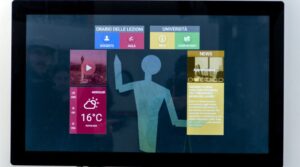
In recent years, touchless-enabling technologies have been more and more adopted for providing public displays with gestural interactivity.
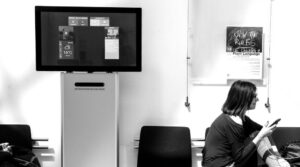
It is well known from prior work, that people interacting as well as attending to a public display attract further people to interact. This behavior is commonly referred to as the honeypot effect.
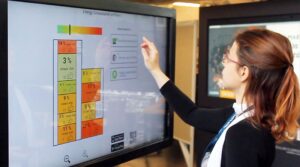
Public displays have been used as a persuasive technology in many prior works.

Twenty-five years past the Weiser’s vision of Ubiquitous Computing, and there is not a clear understanding of what is or is not a pervasive system.
