
Real-Time Body Gestures Recognition Using Training Set Constrained Reduction
Gesture recognition is an emerging cross-discipline research field, which aims at interpreting human gestures and associating them to a well-defined meaning.

Gesture recognition is an emerging cross-discipline research field, which aims at interpreting human gestures and associating them to a well-defined meaning.

In the last twenty years, robotics have been applied in many heterogeneous contexts. Among them, the use of humanoid robots during musical concerts have been proposed and investigated by many authors.
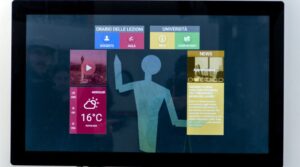
In recent years, touchless-enabling technologies have been more and more adopted for providing public displays with gestural interactivity.

It is well known from prior work, that people interacting as well as attending to a public display attract further people to interact. This behavior is commonly referred to as the honeypot effect.
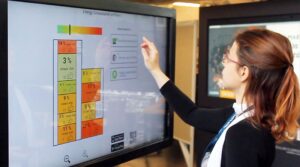
Public displays have been used as a persuasive technology in many prior works.

In the last few years, the use of gestural data has become a key enabler for human-computer interaction (HCI) applications.

Twenty-five years past the Weiser’s vision of Ubiquitous Computing, and there is not a clear understanding of what is or is not a pervasive system.
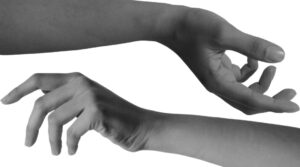
Questo lavoro descrive un metodo per rilevare le emozioni dai gesti utilizzando dati gestuali e una descrizione testuale del loro significato.

One of the most common and efficient way to preserve ancient books is to digitize them, and make their content someway browsable.
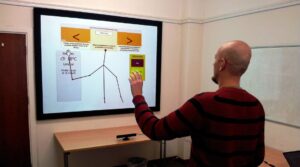
Public displays have lately become ubiquitous thanks to the decreasing cost of such technology and public policies supporting the development of smart cities.
